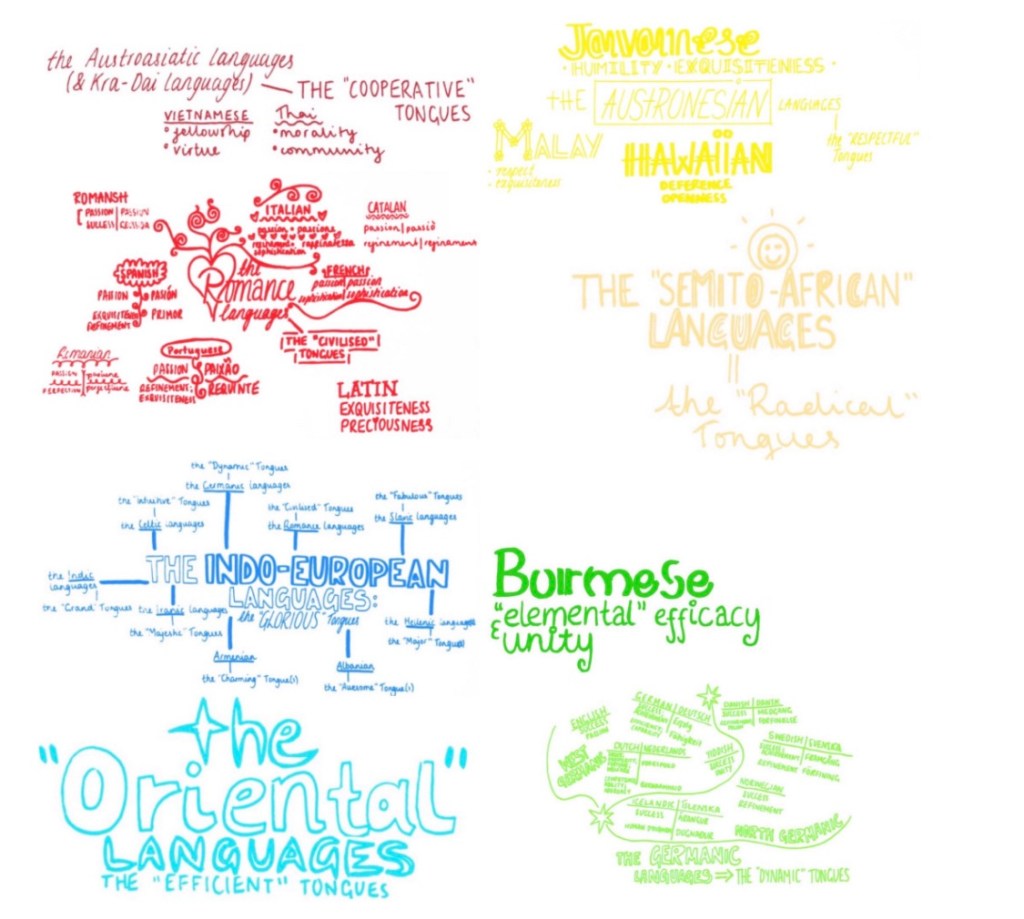
It is true that the sphere of every language in the world hinges on some concepts that serve to guide native speakers in their lives, through the ups and downs of one’s lifelong relationship with one’s mother tongue. Before modern society evolved, Buzz-Concepts sort of coded tribal life. Languages have developed in concordance with the nature of their “BuzzWords” or “Buzz-Concepts” (as I prefer to call them due to translation complexities).
It really helps to consider the components of language as “signs” that direct to meaning and significance. This helps us understand the differences between languages. Every single language on Earth has its own differentiated approach to making use of the “linguistic sign”. In fact, this is literally exactly what Buzz-Concepts really are: the concepts that subliminally guide speakers in making use of the network of signs that make up your language. In English, we seek especially to have success, to be successful, in doing so. In French, Italian, Spanish, Portuguese, native speakers are all ferociously passionate about using their beautiful mother tongues. In Russian, they’re perfectionists when it comes to making use of the linguistic sign. In Chinese, they seek to attain the ideal of efficacy in making use of their linguistic signs. There are so many languages with fascinating ideologies and rationales, with fascinating relationships with their Buzz-Concepts. It is crazy, the world we live in.
In Ancient Egyptian, sense and nuance were inherently primitively philosophical. They loved to philosophise, even before the academic discipline of philosophy had matured. This is how they invented so many useful things, including black ink, toothpaste, makeup, papyrus, the calendar, clocks, pyramids, irrigation, mathematics, geometry, surveying, metallurgy, astronomy, accounting, Egyptian hieroglyphics, paper, medicine, the ramp, the lever, the plough, mills for grinding grain, the police, surgical instruments, wigs, mummification. Hieroglyphs can be understood as “metaphysical language”. Sense/nuance in languages around the world… In English it’s flexible… In Italian it’s refined… In Korean it’s logical… In Russian it’s evocative… In German it’s dynamic… In Arabic it’s profound… In spite of what many assume, the world’s languages can thusly be said to differ greatly on the level of sense and nuance. This is true to the extent that the very experience, nature, substance and meaning of the very concept of language vary around the world, from family to family. Again: considering components of language as signs that conduce to meaning, every single language on Earth having its own unique way or methodology of making use of linguistic signs, Buzz-Concepts guide how it all unfolds. For Africans, the linguistic sign is more tangible and they sort of objectify it. For Native Americans, the linguistic sign is more abstract and fluid. In Europe, we love to attach consequence to the use of language… Sense… In Europe it’s glorified… In East Asia it’s efficient… In Africa it’s treasured…!
Noam Chomsky and his universalists once insisted upon the fundamentalism of linguistic universals, but the opposing doctrine to linguistic universalism, that of linguistic relativism, is more interesting for The Buzz-Concept Project. Linguistic relativism or relativity came to the forefront of linguistics in the form of the Sapir-Whorf hypothesis in the 1920s. The hypothesis asserts that “the structure of a language determines a native speaker’s perception and categorization of experience.” It was met with widespread criticism and dismissal. Noam Chomsky came into the picture a couple of decades later and shifted attention towards linguistic universalism. Linguistic relativity postulates that one’s experience of life unfolds relative to one’s language, while linguistic universalism dictates that we are all biologically programmed to use language in a universal way.
“We cut nature up, organize it into concepts, and ascribe significances as we do, largely because we are parties to an agreement that holds throughout our speech community and is codified in the patterns of our language” – Benjamin Whorf
“Human beings… are very much at the mercy of the particular language which has become the medium of expression for their society.” – Edward Sapir
“A different language is a different vision of life,” said Federico Fellini. Indeed, it is undeniable to me that the features of the language(s) you speak as a native have a profound influence on the precise ways in which you understand the world around you. But unfortunately the field of linguistics is biased from a Western perspective. For example, they have a looser relationship with words in Chinese, and idealise going by concept; they prefer to conceptualise their way through phraseology, which is why Chinese is still written in contiguity without spaces (scriptio continua). The world’s linguistic study is biased towards a prestiged selection of linguistic spheres that aren’t wholly representative and generalisation is relied upon too heavily. Some people and perspectives are neglected and thus our capacity to understand language is tainted by Western bias – also by Indo-European bias, which is the macrofamily major world languages including English, German, French, Italian, Spanish, Portuguese, Russian, Greek, Farsi and Hindi belong to.
This failure within academia has in fact had colossal sociopolitical implications across the world, especially due to the existence of “Buzz-Concepts”! Western thinkers sit atop this pile for a reason but things have gone too far and entire continents are being stumped here. Buzz-Concept clashing forms a very real barrier to human progress and it’s stunning how much insight you can gain into a culture just by knowing your Buzz-Concepts.
 The Buzz-Concept Project