The Buzz-Concept Project is a way of examining the diversity among the world’s languages. Through this perspective, you can develop insight into a language you never imagined possible to have.
Every language has key concepts that provide key intelligence about how its speakers and its society function. People have strong cultural appetites when it comes to their Buzz-Concepts, and so beyond linguistic productivity including literature, Buzz-Concepts play an immense role in influencing art and other cultural customs. Like how Ferdinand de Saussure divided language signs between signifier and signified, and divided language into langue and parole, there are two main mediums to interpret Buzz-Concepts from an analytical standing: lexicologically and visually. I would love to produce a full written guide to the world’s languages by analysing Buzz-Concepts, but it’s such hard graft and I still have much more writing experience to amass before I could fulfil my vision. So far I have relied a lot upon visualisation, with my own graphics and other people’s art, to make my way across the world’s Buzz-Concepts. This pathway can be just as tricky as the lexicological strategy, but is more fun, which is why I started The Buzz-Concept Project this way.
You may not realise it, but the way you and your compatriots make use of the lexicon of your native language(s) is underpinned by some connected concepts, the most overarching of which we’ll call the primary Buzz-Concept. The way a language is created from the beginning of its existence is also influenced by these concepts.
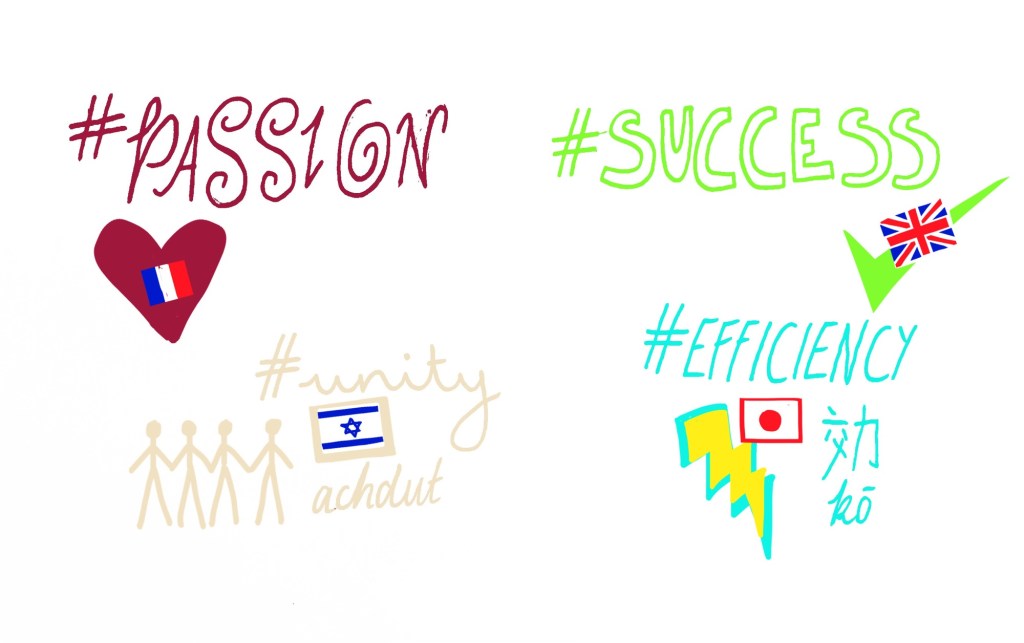
The Buzz-Concept of French/français is passion. The French word for ‘passion’ is passion /pa.sjɔ̃/, so the native BuzzWord of French is passion, spelt the same as in English (the English word is derived from French) but pronounced quite differently. French speakers are very passionate about their mother tongue, known as la Belle Langue. French is also even known as “The Language of Love”. French is a Romance language, derived from Latin and related to Italian, Spanish, Portuguese, Catalan, Romanian, and more. Other Romance languages also buzz about passion, but the Buzz-Concept of Latin was excellency.
The Buzz-Concept of English is success, descended from the Latin word ‘successus’, which meant “an advance, a coming up; a good result, happy outcome”. Yet English is not so closely related to Latin, rather being a Germanic language with closer ties to Dutch, German and Scandinavian languages. The Buzz-Concept success is shared across the Germanic languages, though the others mostly use more authentic Germanic terms rather than the Latin-derived word ‘success’ in English (Erfolg in German; voorspoed in Dutch; framgång in Swedish; medgang in Danish – though Norwegian has adopted the English loanword suksess). Modern English is descended from the early variant called Anglo-Saxon or Old English, which was unintelligible for Modern English speakers. This was spoken in the first millennium AD, before English acquired extensive French and Latinate vocabulary, becoming Middle English, after the Norman Conquest of the 11th century. The Buzz-Concept of Old English was instead spede, meaning “success, prosperity, or good fortune“. This term is related to the modern word ‘speed’, as in “God speed”. Within the other Germanic languages, we have the related word ‘voorspoed’ of Dutch (voor + spoed = for-speed). Speakers of Germanic languages focus on success, as communicators and in other ways. Don’t assume that speakers of other language families don’t also strive for success, because of course they do, while Germanic speakers just like their astuteness to lay conveniently on top of what everybody else achieves. For the most part, success is an intrinsic quality of human language; it is a given, you might say. Sometimes Germanic speakers double up over this, often not, sometimes they buckle instead. This dynamic is intentional within the design of the Buzz-Concept success, to force people to learn from experience. The Buzz-Concept success can be straightforward, it can be subversive.
The Buzz-Concept of Hebrew/עִבְרִית/Ivrit is unity/אַחְדוּת/achdut. Explaining why Jewish communities are so tightly bonded, and making the Holocaust seem even more awful -due to Hitler’s mockery of the Buzz-Concept unity. Hebrew speakers don’t lose sight of the fundamental purpose of language as a means of communication within a community. They don’t forget about the interpersonal role of human language.
The primary Buzz-Concept of Japanese/日本語/Nihongo can be encapsulated by the sole character 効 kō meaning “effect, efficiency”. This very easily explains why the Japanese love technology so much, and why they’re so good at making it. The Japanese are also naturally very efficient communicators.
Do you speak any of these languages? Natively? If not, can you identify what your language buzzes about? Are you excited for The Buzz-Concept Project to cover it?
 The Buzz-Concept Project